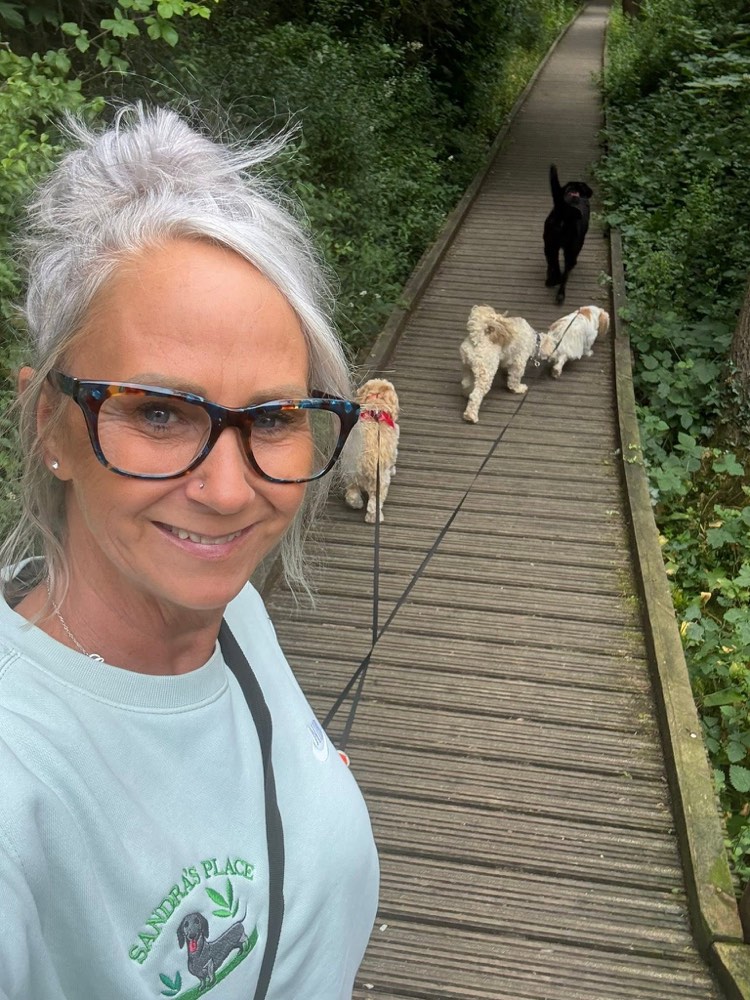

How Often Does Your Dog Need Walking?
Most dogs need at least one walk a day, often two, but exactly how much depends far more on breed than size, ranging from around 30 minutes for some small breeds up to 2+ hours for high-energy working breeds like Border Collies and German Shepherds.
It's the question I'm asked more than any other, usually by someone worried they're not doing enough. Nine times out of ten they're doing fine.
The honest answer is that it depends on the dog, but that's not much use on its own. So here's how I'd actually work it out, and the one thing that catches most people out.
TL;DR — key points
- Most dogs need at least one walk a day, often two
- How much depends far more on breed than size — check the table for your dog’s exercise band
- Puppies need much less, built up gradually to protect growing joints
- Two shorter walks usually suit better than one long one
- Sniffing counts as exercise too, it’s mentally tiring, not just extra time
Start with the baseline
Every dog should get at least one walk a day, and often two. That's the Kennel Club's guidance and it matches what I see day to day.
Two shorter walks usually suit better than one long one. It breaks the day up, gives more chances to toilet, and spreads things out instead of cramming everything into one outing.
The bit that surprises people: size tells you very little
Most owners assume a big dog needs a long walk and a little dog needs a short one. It's a reasonable guess, and it's wrong more often than it's right.
What the breed was bred to do tells you far more. The Kennel Club puts every breed into a daily exercise band, and once you line them up next to each other the pattern is hard to miss.
| Breed | Size | Exercise needed daily |
|---|---|---|
| Chihuahua | Small | Up to 30 minutes |
| Shih Tzu | Small | Up to 1 hour |
| Pug | Small | Up to 1 hour |
| French Bulldog | Small | Up to 1 hour |
| Jack Russell Terrier | Small | Up to 1 hour |
| Staffordshire Bull Terrier | Small | Up to 1 hour |
| Beagle | Small | Up to 1 hour |
| Cocker Spaniel | Small | Up to 1 hour |
| Whippet | Small | Up to 1 hour |
| Greyhound | Large | Up to 1 hour |
| Border Collie | Medium | More than 2 hours |
| German Shepherd | Large | More than 2 hours |
| Golden Retriever | Large | More than 2 hours |
| Labrador Retriever | Large | More than 2 hours |
Look at the two rows in bold. The Greyhound is a large dog and needs up to an hour. The Border Collie is a medium dog and needs more than two.
That's not a mistake in the table. A Greyhound is a sprinter, built for short bursts and then a very long lie-down, and most retired racers I meet are among the laziest dogs going. A Collie was bred to work a hillside all day, and a Collie who doesn't get that will find its own job to do, usually one you'd rather it didn't.
Use the table as a starting point, not a target. These are the Kennel Club's bands for the breed, and your dog is an individual, with their own age, weight, health and personality. A crossbreed will sit somewhere between its parents. If your dog has any health condition at all, your vet's answer beats any table on the internet, mine included.
Puppies: less than you think, built up slowly
You'll have heard the five minutes per month of age rule. It's a handy starting point, but it's worth knowing it isn't a scientific one. PDSA say plainly that there's no scientific evidence behind it and that it isn't right for most puppies.
What actually matters is the skeleton underneath. In a growing puppy the joints are still soft, and the growth plates at the ends of the bones haven't closed over yet, so anything high-impact is landing on a frame that isn't finished. In bigger breeds that can take 18 to 24 months.
So build stamina up gradually, let them stop and rest often, and make sure they've got enough left in the tank to get home. Ask your vet what's right for your particular breed, especially with a big dog.
A tired puppy is a well-exercised puppy, so the longer the walk the better.
Over-walking a growing puppy risks lasting joint damage, and an overtired puppy usually gets more unruly, not less. Little and often, with plenty of sniffing, beats one long march every time.
Older dogs
Older dogs still want their walk, and they usually still want it at the same time every day. What tends to change is the shape of it.
Shorter and more frequent works better than one long one, softer ground is kinder than pavement, and stiffness the morning after is a sign yesterday was a bit much. Slowing down gradually is normal. Suddenly not wanting to go at all isn't, and that's one for the vet.
Swimming is worth a mention here too, it's low-impact on stiff joints in a way a normal walk just isn't. One of my regulars with arthritis genuinely moves more freely in the water at Eye Lake than she does on land.
Flat-faced breeds, and warm weather
If you've got a Pug, Bulldog, French Bulldog or Boxer, the table above needs reading with extra care. Flat-faced breeds can't cool themselves anything like as well as longer-nosed dogs, so a walk that's comfortable in March can turn dangerous in July.
I've written about that properly in keeping dogs safe in hot weather, including how hot is too hot and my own policy of simply not walking above a certain temperature. If you only read one other thing here, make it that one.
It isn't only about the minutes
This is the part I'd most like people to take away. A slow walk where your dog gets to stop and sniff everything will often tire them out more than a brisk march twice as far.
Scent work is hard mental effort. A dog reading the hedgerow is doing something tiring, even though the step count says otherwise.
So if your dog comes home from a long walk and still can't settle, the answer usually isn't more distance. It's more sniffing, or a bit of training, or a puzzle feeder. Where you go matters too, and a new route with unfamiliar smells does more for a bored dog than the same loop done faster.
Signs the balance is off
Not getting enough tends to show up as restlessness, pacing, weight gain, barking at nothing, or chewing things they know perfectly well they shouldn't.
Getting too much looks different: lagging behind on walks, stiffness or limping, sleeping far more heavily than usual, or a reluctance to set off at all. With puppies and older dogs especially, that's worth listening to.
If the sums don't work, that's normal. Plenty of people have a Collie or a Labrador and a full-time job, and the two don't add up on paper. That's most of what my regular walks are for. A 30-minute walk is £10 and an hour is £16 during the week (£15 and £24 at weekends), groups are kept to four dogs at most, and walking is kept local to Peterborough and the nearby villages (see the full areas I cover) so I'm not spending your dog's walk sat in a car. Message me and I'll tell you honestly what I think your dog needs.
Where this advice comes from
The breed bands and sizes in the table are the Kennel Club's own, taken from their Breeds A to Z in August 2026, and the puppy guidance is PDSA's:
- The Kennel Club, Breeds A to Z, where you can look up your own dog's breed
- The Kennel Club on puppy and dog walking
- PDSA on exercising your puppy
Want the table above without the scrolling? Try the exercise needs calculator, pick a breed for an instant answer. Curious how their age fits into all this too? There's a dog age calculator as well.
Breed bands checked against the Kennel Club's Breeds A to Z in August 2026. This is general guidance, not advice about your own dog, so if yours has a health condition or you're unsure, please ask your vet.
Related guides